Better than Joola and Selkirk for 40% Less – More Tech + Custom Design + Great Paddle

For the best experience this application needs your location. Please allow in your browser.
Better than Joola and Selkirk for 40% Less – More Tech + Custom Design + Great Paddle
For the best experience this application needs your location. Please allow in your browser.
The idea that pickleball belongs to retirees has missed the latest serve. Teens and young adults are joining the game, and their participation is changing how pickleball looks, feels and grows.
According to the Sports & Fitness Industry Association (SFIA), ages 13–24 had the highest pickleball participation rate of any age segment in its 2026 report. That describes the share of people in that age group who played, rather than the age group with the largest total number of players. It is still a striking answer to anyone who thinks young players are sitting this sport out.
Pickleball’s appeal crosses generations, but younger players now have more ways to enter the sport and keep improving. A first game with friends can lead to regular open play, lessons or a junior tournament. Each step offers a different reason to come back: the fun of a close rally, the challenge of learning a new shot or the satisfaction of competing under pressure.
USA Pickleball has a dedicated junior pathway for players under 18, including junior divisions at select tournaments. Those events offer singles and doubles competition, giving developing players a place to test their skills against others.
Access matters, too. In 2026, USA Pickleball announced a partnership with Boys & Girls Clubs of America to bring equipment and structured programming to Clubs. Programs like this can put a paddle in a young person’s hand before they have ever considered joining a tournament or buying their own gear.
It is easy to learn enough pickleball to play a game. It takes considerably more work to control a fast exchange, recognize an opening and choose the right shot. That gap gives ambitious players plenty to chase.
A younger player might start out trying to hit every ball hard. As opponents get better, the game demands more: a reliable serve, patient resets, smart positioning and the ability to switch from defense to attack. Singles adds the challenge of covering the court alone; doubles asks partners to communicate and move together.
That range is part of pickleball’s appeal. New players can enjoy a casual match while experienced players work on specific skills. The sport has room for both, and the route from one to the other is clear enough to keep practice interesting.
For many young players, the best part of pickleball starts with a simple invitation: “Want to play?” Doubles makes it easy to meet a partner, rotate into another game and play with people who bring different styles to the court.
You do not need a tournament entry to feel part of the game. A regular group can create its own rivalries, running jokes and reasons to show up next week. That social side helps explain why a match can become a routine, even for someone who never planned to take up a new sport.
The appeal also reaches across ages. Younger players can learn from experienced opponents, and those opponents may have to adapt to a different pace or style in return. Pickleball does not need to lose its older players to welcome its next generation. A court is more interesting when both are on it.
As players spend more time on court, they begin to notice what feels right in their hands. Some want a paddle that suits an attacking game. Others care most about touch, maneuverability or a familiar response during quick exchanges.
The smart way to choose is to start with how you actually play, then try a paddle when possible. Pay attention to comfort, control and how it feels late in a session. A product description can tell you what a paddle is designed for; time on court tells you whether it suits you.
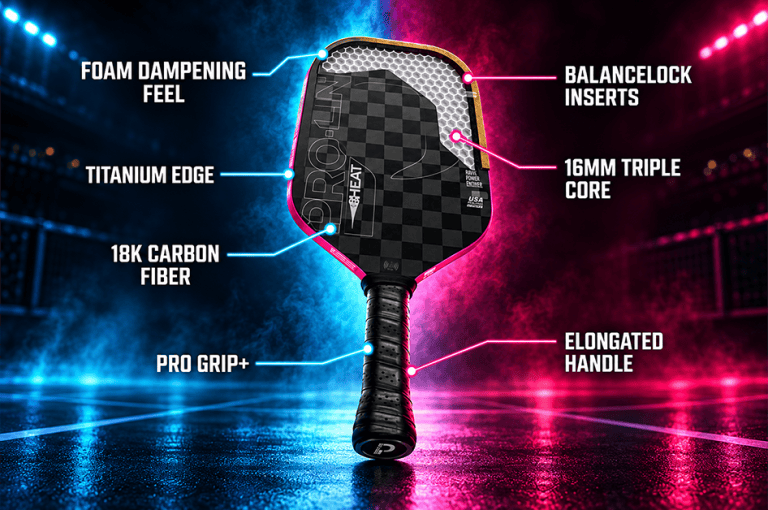
For example, Pro-Line describes its HEAT paddle as an elongated option for players seeking power, with an adjustable balance system. That may interest a player developing a more aggressive style, though it is not automatically the right fit for every young athlete. The broader Pro-Line Paddle lineup gives players a place to compare options as their game develops.
Youth pickleball has momentum, but its future depends on more than participation figures. Young players need welcoming places to begin, people to play with and opportunities to progress when they want a bigger challenge. Community programs and junior events help create that path.
The biggest shift may be in how people picture a pickleball player. There is no single age, level of intensity or way to enjoy the sport. The next generation is bringing new energy to the court while sharing it with the players who were already there.
Ready to find the paddle that fits your game? Explore the Pro-Line Paddle lineup and choose how you want to play.
Yes. SFIA reports that ages 13–24 had the highest participation rate of any age segment in its 2026 pickleball report.
Yes. USA Pickleball offers junior divisions at select tournaments, including singles and doubles events for younger players.
No. A beginner can start by learning the game with an available paddle. Once they know how they like to play, they can make a more informed choice about their own equipment.
No. Players can enjoy a relaxed game with friends, work steadily on their skills or enter organized competition. That flexibility is one reason different generations can share the same court.


BalanceLock technology for pickleball BalanceLock technology for pickleball paddles best pickleball paddle for spin control control pickleball paddle Customizable pickleball paddles Durable pickleball paddles Elevate your pickleball game High-performance pickleball paddles High-performance pickleball paddles for 2025 How to choose a pickleball paddle Innovative pickleball paddle features pickleball community Pickleball paddle guide Pro-Line paddles Pro-Line Paddles innovation Sweet spot optimization in pickleball paddles Toray+ Toray+ carbon fiber paddles Toray+ carbon fiber pickleball paddles