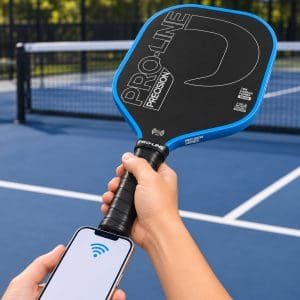
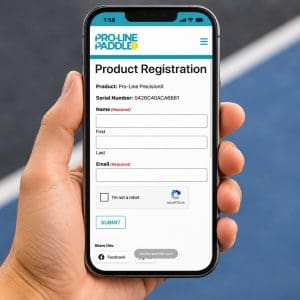
For example, a manufacturer might connect a paddle’s identifier to a registration record. Scanning the tag can provide a route to that record or to a setup process. You may still need to enter purchase details, create an account or complete a form. A successful scan and completed registration are separate steps.
The phrase “smart pickleball paddle” does not tell you whether the paddle has performance sensors. Measuring swing speed, ball spin or contact location requires capabilities beyond reading an NFC tag. Look for an explicit description of any data the equipment collects rather than assuming that a chip records what happens during a match.
What NFC Does Not Establish
An NFC chip is not a GPS tracker. It must be close to a compatible reader to exchange information; it cannot independently report where the paddle is from inside a bag or across a parking lot. If a connected service records the location of a scan, that relies on additional software and the scanning device’s settings and permissions.
Lost-paddle features should be understood in that context. Marking a paddle as missing may support a recovery process, but someone still has to find it and interact with the system. Recovery is not guaranteed. Nor should you assume that a scan automatically reveals the finder’s name, contact information or precise location.
A digital registration record also does not establish tournament eligibility. Registration and equipment approval serve different purposes. Before competing, check the exact model’s current approval status and the organizer’s requirements.
Finally, NFC does not determine how a paddle plays. The chip’s registration function does not add spin to a drive or improve touch on a reset. Those results depend on the player’s technique and the paddle’s physical design.
Compare the Ownership Experience
Two manufacturers can use NFC and offer different experiences after the scan. One may direct you to a web form; another may require its own app. The presence of a chip does not establish a standard registration process or a common set of benefits.
Pro-Line’s published process describes a scan followed by a registration form. JOOLA currently documents registration for its NFC-enabled paddles through the JOOLA Infinity app. These are separate systems, so instructions and warranty conditions should not be transferred from one brand to the other.
When comparing an NFC pickleball paddle with another option, check:
- Whether your phone supports the required scan and where the tag is located.
- Whether you need an app, an account or an internet connection to complete the connected process.
- What registration unlocks and whether any benefits have a deadline.
- What information the service collects and what may be visible when someone scans a registered paddle.
- What support is available if the scan or registration does not work.
These questions tell you more than the word “smart.” A feature is easier to evaluate when the manufacturer explains what you can actually do with it.
Choose a Paddle for Your Game
Treat NFC as one part of the ownership experience when choosing equipment. First consider whether the paddle’s weight, shape and grip fit your preferences, along with how it responds during the shots you play most.
Two models can share the same registration technology while feeling different on court. Within Pro-Line’s lineup, for instance, HEAT has an elongated shape while PRECISION has a wider profile. Shared PaddleTag functionality does not make those physical designs interchangeable.
If you can demo a paddle, compare familiar drives, blocks and softer shots. Notice whether you can position the face comfortably and repeat the placement you intended. Then consider whether the connected ownership features add something you would use.
NFC can be a useful convenience. It is not a substitute for choosing a paddle that suits your game.