For the best experience this application needs your location. Please allow in your browser.
For the best experience this application needs your location. Please allow in your browser.
What makes a pickleball paddle suitable for all-court play? A useful combination of touch for soft shots, manageable pace for attacks and handling that lets you move between the two. An all-court paddle aims to support your full range of shots without making one priority dominate every exchange.
If you are searching for the best all court pickleball paddle, start with the shots you need it to handle. A hard drive tells you little about a paddle’s response on a defensive reset. The right fit should earn your confidence in both situations.
All-court is a practical buying description, not a formal certification or standardized technical class. Brands may use the term differently, so treat it as a starting point for comparison rather than a performance guarantee.
Picture a rally that begins with a deep serve, moves into a patient dink exchange and ends with a quick block against a speedup. An all-court design is intended to remain useful throughout that sequence. It does not need to produce the fastest drive or the softest response in isolation.
Spin belongs in that evaluation, too. Try the topspin drive or roll volley you actually use. Surface construction matters, but a carbon-fiber label alone cannot tell you how much rotation you will produce. Your swing path, contact and timing remain part of the result.
A power-focused paddle emphasizes attacking pace. A control-focused paddle emphasizes touch and placement. An all-court paddle aims to offer a useful mix of those priorities.
These descriptions overlap. A control-oriented design may supply all the pace you need, while a power-oriented option may still suit your soft game. Look for a product description that explains the intended tradeoffs and specifications that help you compare the options.
Our guide to choosing a pickleball paddle explains the broader selection process. Use this article to narrow the all-court question rather than relying on a skill rating to choose for you.
Read the complete model description. Surface material, texture and core construction are relevant design details, but neither carbon fiber nor a 16mm thickness proves all-court performance on its own.
For spin, look at the manufacturer’s surface description without treating it as a measured spin score. Your swing path and contact also affect the result. For core thickness, use our 16mm paddle guide to understand the terminology before comparing models.
Compare overall length and width, then check usable handle length and grip circumference separately. Matching face dimensions do not establish identical handle fit.
Your current paddle can provide a useful reference. If you like its width or need room for a two-handed backhand, identify those dimensions before shopping. Compare them with the candidate’s published measurements. When a measurement is missing, ask for it rather than estimating from a photograph.
Check whether a listed weight is a nominal figure, a range or a specification for a particular configuration. An overgrip or added accessory changes the finished setup, so compare like with like where the information allows it.
Total weight does not describe everything about handling. The balance point identifies where the paddle balances along its length. Swingweight describes resistance to rotation during a swing. Two paddles with the same total weight can feel different because their mass is distributed differently.
Use published measurements when available. If balance or swingweight is not supplied, treat it as an unanswered question rather than inferring it from the model name or total ounces.
A balanced pickleball paddle may simply mean a paddle marketed around a mix of playing characteristics. It does not necessarily mean the paddle has an even physical balance point.
Keep those meanings separate. A broad performance description can explain a model’s intended role; a measured balance point describes a physical property.
You do not need a long list of models. Start by writing down what you want to keep from your current setup and what you want to change.
For each candidate, record the exact model, key dimensions, listed weight, documented features, current price and purchase terms. Mark missing information clearly. This gives you a practical comparison without turning uncertain details into facts.
If a missing measurement or compatibility detail could change your decision, contact Pro-Line with questions about specifications or compatibility.
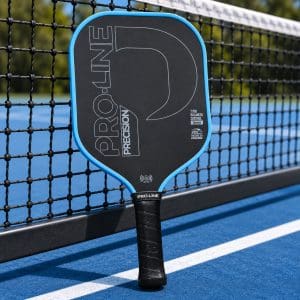
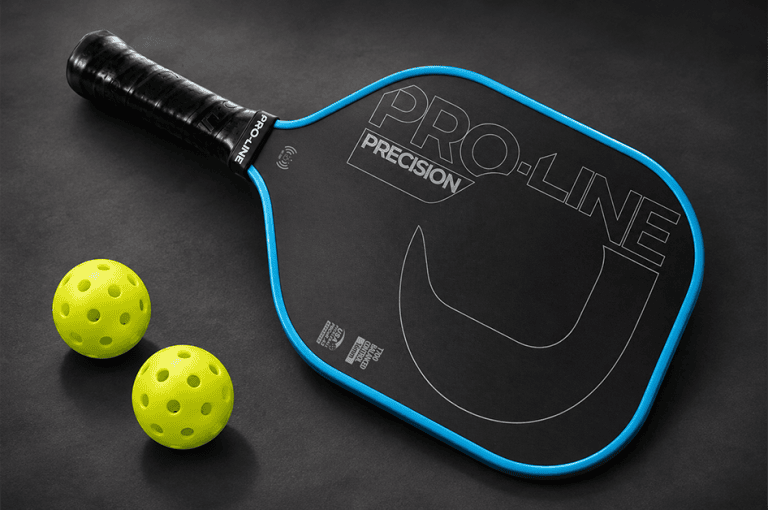
Pro-Line positions PRECISION around control and versatility for balanced play. That makes it a relevant starting point when you want to consider an all-around option rather than choose solely for maximum pace.
Our product FAQ lists PRECISION at 16 inches long, 8 inches wide and 8.1 ounces, and describes T700 carbon fiber, a triple-core design and a traditional edge guard. These are published product details, not proof of an independently tested performance ranking.
Use them to compare PRECISION with the dimensions and weight you already know you prefer. Review the current product listing before ordering, and ask Pro-Line about usable handle length, grip circumference or any configuration detail that is important to you.
PRECISION’s intended all-around role does not mean it is the right choice for every player. The question is whether its documented features match the priorities you identified.
You value both soft exchanges and attacks, and neither is your only priority. Start with an all-court candidate such as PRECISION. Compare its published specifications with your current equipment preferences, then resolve important gaps with Pro-Line before buying.
If your main purchase goal is power, review the power paddle guide. Consider the handling and control tradeoffs described for the model rather than assuming an all-court label will meet that specific goal.
If you already generate enough pace and prioritize dinks, drops and resets, begin with the control paddle guide. Compare the documented options against what you like and dislike about your current paddle.
Start with your priorities, compare the documented details and get answers to the questions that could affect your purchase. An all-court paddle is worth considering when you want versatility across the shots you use most.
Explore Pro-Line PRECISION specifications and browse the current paddle selection. Review current availability and purchase policies before checkout, and contact Pro-Line if you need a specification clarified.
The descriptions overlap. A control paddle emphasizes touch and placement; an all-court paddle emphasizes usefulness across soft shots, attacks and defensive exchanges. Read the model’s intended role and specifications rather than treating either label as a strict category boundary.
Not necessarily. Balanced may describe a mix of power, control and handling. An even balance point is a physical characteristic that requires measurement. One description does not establish the other.
Yes. One paddle can suit both if its characteristics fit your priorities in each format. Consider the reach, pace and placement you want for singles alongside your handling and soft-game priorities for doubles. You do not automatically need separate paddles for the two formats.
No. Thickness is one design detail. Evaluate the full model description, shape, weight and intended use together. A single specification does not establish how well a paddle will fit your game.

Buyer Guide Durable pickleball paddles Elevate your pickleball game Heat Heat Paddle pickleball paddle comparison Pickleball paddle guide Precision Precision Paddle Pro-Line HEAT paddle Pro-Line paddles Pro-Line Precision paddle Pro-Line Spin Light Paddle Pro-Line Spin Paddle Spin Spin Light Spin Light Paddle spin paddle Sweet spot optimization in pickleball paddles Toray+ carbon fiber pickleball paddles