For the best experience this application needs your location. Please allow in your browser.
For the best experience this application needs your location. Please allow in your browser.
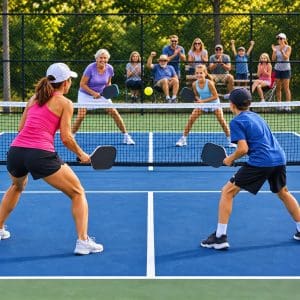
Looking for fun pickleball games to play with family and friends this Thanksgiving? Try a cooperative dink challenge, a serve-to-target challenge, or short games with rotating partners. Choose according to your group’s experience, available time, and interest in keeping score.
These are suggested recreational activities with shared goals and house arrangements you can adjust together. You can start with a few gentle exchanges, switch activities, or take a break whenever your group is ready.
Use this table to pick a starting point. Times are suggestions, including turns and brief explanations.
Activity | Players at a Time | Equipment | Suggested Time | Best Starting Point |
|---|---|---|---|---|
Cooperative dink challenge | 2; others rotate in | Two paddles, one ball, court and net | 5-8 minutes | A shared goal with no opposing score |
Serve-to-target challenge | 1 server; others wait clear | Paddle, balls, court and net; optional flat markers | 5–8 minutes | Short individual turns |
Partner-rotation games | 4; remaining players rest | Four paddles, ball, court, net and timer | 6 players: 10–15 minutes; 5 players: 20–25 minutes | Players ready for short doubles rounds |
A dink is a soft shot played near the kitchen—the non-volley zone beside the net—that lands in the opponent’s kitchen.
For this challenge, two players work together:
An attempt ends when you reach the target or the exchange breaks down: the ball does not cross the net, lands outside the kitchen, bounces twice before being returned, or is volleyed instead of played after a bounce. Start the next attempt at zero.
With four participants, switch the active pair after three attempts. An attempt finishes when the pair reaches its target or the exchange breaks down. With a larger group, use a queue and give each pair the same number of attempts.
For newcomers, start with three contacts and gentle feeds within comfortable reach. Pause between attempts to explain anything unfamiliar.
For experienced players, raise the target to ten or alternate forehand and backhand contacts. Keep the aim cooperative: send a ball your partner can return rather than trying to win the exchange.
These targets belong to the challenge, not match scoring.
Give each player five serve attempts from the same serving side.
Choose a target within the diagonally opposite service court. The whole service court makes a useful opening target. Count one house point for each legal serve whose first bounce lands in the agreed target.
Serve from behind the baseline into the diagonally opposite service court. Use a legal volley serve or drop serve; review the linked beginner guide if these are unfamiliar. The serve must clear the kitchen and its line. The other boundary lines of the correct service court count as in. A net-touch serve still counts if it lands legally.
Use existing court lines to describe smaller targets. Optional flat markers should stay outside movement paths; do not place loose balls or raised objects underfoot.
Only the server is active. Everyone else waits clear. Pause if a loose ball enters the server’s footing area. After the turn, stop play, retrieve the balls together, and bring in the next server.
New players can aim anywhere in the correct service court. Experienced players might aim for its deeper half, agreeing beforehand where that target begins.
Different targets let people work toward their own goals. Keep the five-attempt turn consistent, and compare personal progress rather than requiring everyone to use the smallest zone.
For serving and match basics, read the beginner’s guide to pickleball.
Put four players on court for doubles and use rounds of three or four minutes. With six players, complete three rounds so everyone rests once; allow about 10–15 minutes including player changes. With five players, complete five rounds and allow about 20–25 minutes. These are suggested planning allowances; finish the current rally before rotating.
Use traditional side-out scoring throughout: only the serving team scores. Explain the scoring before beginning, including the opening 0–0–2 call.
At the timer, finish the current rally, then stop and rotate. Record the score if your group wants; a tie can stay a tie. Begin each new round at 0–0–2.
The timer and rotation are recreational arrangements. Standard playing rules still apply during rallies; consult USA Pickleball’s rules summary when needed.
Assign letters to players and follow the appropriate schedule.
Five players
Round | Team 1 | Team 2 | Resting |
|---|---|---|---|
1 | B + C | D + E | A |
2 | A + D | C + E | B |
3 | A + E | B + D | C |
4 | A + C | B + E | D |
5 | A + B | C + D | E |
Six players
Round | Team 1 | Team 2 | Resting |
|---|---|---|---|
1 | C + E | D + F | A + B |
2 | A + F | B + E | C + D |
3 | A + D | B + C | E + F |
Complete the full schedule so everyone receives one rest before anyone rests again. If you have time for another cycle, change partnerships while preserving equal rest turns.
Assign letters thoughtfully to balance experience where possible. Avoid making one player responsible for teaching throughout the gathering.
Ask what people have played before and what pace they prefer. Explain one activity at a time, then begin with a short example.
Offer breaks and room to opt out. Someone may enjoy one serving turn and prefer to watch the next activity. Cooperative goals also give the group something to celebrate beyond winning.
Before leaving home, check court access, Thanksgiving opening hours, reservation requirements, and venue policies. Holiday availability may differ from the usual schedule.
Keep the packing list short:
Check grips and visible equipment condition before play. Existing suitable gear is enough to join these activities.
Save or share the activity table, ask your group which option sounds appealing, and start there. You can keep the gathering to one challenge or try all three.
If you need equipment, explore the Pro-Line Paddle collection.
Try a cooperative dink challenge with a three-contact goal or a serving challenge using the whole service court as the target. Gentle feeds and short turns give players time to understand the activity. Adjust the goal to the people participating.
Yes. Agree on pace, use cooperative goals, and adjust targets to experience. Rotate partners and offer breaks. These choices help accommodate differences, although one activity may not suit everyone. Ask participants what they enjoy rather than assuming they want competitive games.
Keep four players active during doubles and rotate the others through short timed rounds. With five players, one rests each round; with six, two rest. The tables above give everyone a rest before anyone sits out again.
You need suitable paddles, pickleballs, a marked court, and a net. Bring court shoes and water, plus a timer for rotation games. Target markers are optional because you can use existing court zones. No particular paddle brand is required.
No. The shared rally goals, target points, and timed rotations are suggested recreational arrangements. They help organize a social session. For standard matches, follow the official pickleball rules and the scoring format agreed before play.

Beginner pickleball tips Buyer Guide control pickleball paddle Elevate your pickleball game Heat Heat Paddle pickleball paddle comparison Pickleball paddle guide Precision Precision Paddle Pro-Line HEAT paddle Pro-Line paddles Pro-Line Precision paddle Pro-Line Spin Light Paddle Pro-Line Spin Paddle Spin Spin Light Spin Light Paddle spin paddle Sweet spot optimization in pickleball paddles