Coming Soon | 2025 product of the year for serious pickleball players
Pro-Line has the Best Product Specs in the market – Learn More
Want to change the balance of your paddle – Check out BalanceLock
You want to personalize your paddle design – check out EdgeArmor Skinz
You don’t want to miss the release of Pro-Line Paddle – Signup for the latest updates below

For the best experience this application needs your location. Please allow in your browser.
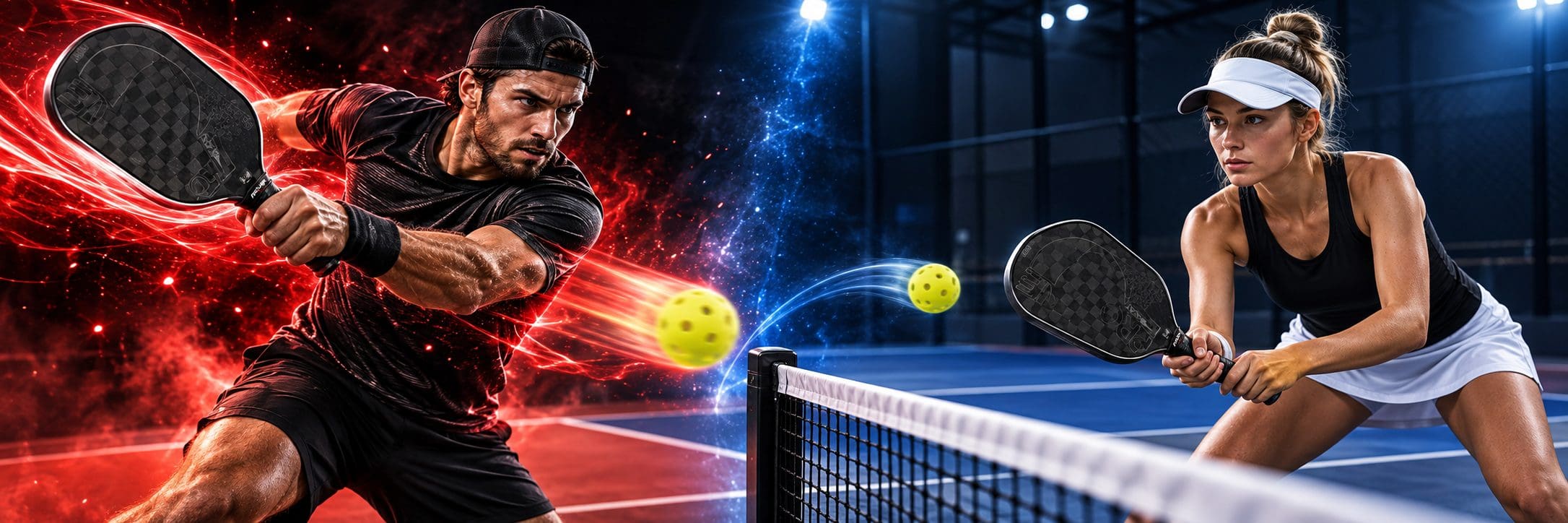
Every pickleball court eventually becomes a laboratory for the same experiment: power or patience?
On one side is the player who drives nearly everything. Hard serves. Third-shot drives. Speedups from questionable locations. If the ball is moving, their instinct is to make it move faster.
On the other side is the player who seems perfectly content to dink for the next three business days. They reset, place the ball carefully, wait for you to get impatient, and rarely give you the attack you want.
Welcome to the great bangers vs. dinkers pickleball debate.
So which style actually wins more games?
The answer is not as simple as choosing power over control. Neither style automatically has the advantage. Winning consistently depends more on positioning, shot selection, consistency, decision-making, and the ability to change tactics when an opponent adjusts.
At lower levels, raw power can overwhelm players who are uncomfortable handling pace. As competition gets stronger, however, predictable aggression becomes easier to defend. Eventually, the best players tend to develop both sides of the game.
The real advantage belongs to the player who knows when to hit hard and when to slow everything down.
A pickleball banger is a player who relies heavily on pace and aggressive offense.
Bangers typically favor drives, hard serves, fast returns, speedups, and attacks whenever they believe they can put an opponent under pressure. Rather than patiently working through a long dink exchange, they often try to end or take control of the rally early.
And against the right opponent, it works.
Hard shots reduce reaction time. Players who struggle with fast balls may pop blocks into the air, miss volleys completely, or get pushed backward from the kitchen line. A strong drive can also punish a ball that sits too high and immediately change the momentum of a point.
Bangers are especially dangerous when they receive an attackable ball. Leave one floating above the net and you may not get another touch.
The weakness appears when aggression becomes automatic.
Harder shots generally provide less margin for error. A player who attacks low balls, drives from poor court positions, or constantly speeds up predictable patterns may begin giving away points through unforced errors.
Good defenders can also turn a banger’s greatest weapon against them. Compact blocks and resets allow skilled players to absorb pace instead of trying to match it.
Once opponents prove they can handle speed, the banger has to answer a different question:
What happens when hitting harder stops working?
A dinker approaches the game from the opposite direction.
Rather than trying to overwhelm opponents with pace, dinkers rely on patience, placement, resets, and soft shots near the non-volley zone.
A strong pickleball dinking strategy is not simply about keeping the ball soft. It is about controlling what the opponent is allowed to attack.
Low, well-placed dinks can force opponents to hit upward, making aggressive attacks more difficult. Carefully moving the ball from one side of the kitchen to the other can also pull opponents out of position and eventually create a higher ball.
That is where patience becomes offense.
Dinkers often win because they refuse to give opponents the ball they want. Instead of attempting difficult winners, they make the other team hit another shot, then another, then another.
Eventually someone gets impatient.
But pure dinking has limitations too.
A player can become so committed to keeping the rally soft that they fail to recognize when the advantage has shifted. If an opponent leaves a ball sitting above net height, continuing to dink may allow them to recover.
Control without aggression can become passivity.
The strongest soft-game players are not trying to dink forever. They are trying to create a ball worth attacking.
The power vs. control pickleball debate changes dramatically depending on the level of competition. The attached brief specifically frames the matchup by skill level rather than declaring one universal winner.
Power can be extremely effective because many players struggle to block fast drives.
Short reaction times create easy points.
Aggressive players may win before a dink rally develops.
Players become better at blocking, resetting, and handling pace.
Pure bangers become easier to predict.
Controlled aggression starts outperforming nonstop power.
Successful players typically combine both styles.
Soft play creates attack opportunities.
Power is most effective when used selectively.
Decision-making becomes more important than simply hitting harder.
Power is useful because it creates pressure.
But pressure and control are not the same thing.
Hard shots travel quickly in both directions. If your opponent has strong hands, the pace you generate can come back almost immediately.
That creates one of the biggest traps for aggressive players: attempting to solve every rally by adding more speed.
Attack from a balanced position against a high ball and power can be devastating.
Attack a low ball while moving, reaching, or standing too far back and the result may be an error or an easy counterattack.
Good defenders also learn to redirect pace rather than fight it. Instead of taking a large swing, they use the incoming speed and guide the ball into space.
That is why power tends to work best when it is earned rather than forced.
Soft play has its own trap.
A player can become so focused on patience that they stop looking for opportunities to attack.
The objective of dinking is not necessarily to produce the longest rally possible. A good dink limits your opponent’s options while helping create a more favorable ball for you.
Eventually, someone may leave the ball slightly too high.
That is the moment the rally changes.
If you refuse to attack when the opportunity appears, your opponent may regain balance, reposition, and return the rally to neutral.
Poorly placed dinks can also become attackable themselves. A ball that sits high or lands too deep near an opponent’s preferred contact point can quickly turn defense into offense.
The purpose of the dink is often not to keep dinking.
It is to create the right ball to attack.
Learning how to beat a banger in pickleball usually starts with resisting the temptation to become one yourself.
Trying to outhit an aggressive player can turn the match into exactly the type of game they want.
Instead, make their power uncomfortable.
Start by keeping returns deep whenever possible. A deeper return gives you more time to move toward the kitchen while forcing the serving team to attack from farther back.
Once you’re at the kitchen, shorten your swing.
Hard drives rarely require huge volley motions. Compact blocks can absorb speed and send the ball back low. When possible, redirect that pace into the kitchen and force the aggressive player to move forward.
Resets are particularly valuable because they change the speed of the rally. A player expecting another fast exchange suddenly has to generate their own pace from a low ball.
Avoid unnecessary speedups from below net height as well. Giving a banger a fast ball from a poor position often invites the counterattack they want.
Above all, make them hit another shot.
Many aggressive players are comfortable winning points quickly. The longer you can keep the ball low, defend their attacks, and force another swing, the greater the chance they eventually take too much risk.
Beating a strong dinker requires a different kind of discipline.
You cannot force the attack simply because you’re tired of waiting.
Stay patient and pay attention to ball height.
When the ball remains below net level, attempting an aggressive speedup can put you in a vulnerable position. Continue working the point instead.
Use placement to move the dinker around the kitchen. Push them wide, change direction when appropriate, and make them contact the ball from less comfortable positions.
Eventually, a dink may sit slightly higher.
That is when controlled aggression becomes valuable.
Selective speedups can prevent a patient opponent from settling into the same rhythm every rally. Changing pace also forces them to defend multiple styles of shot rather than simply winning a soft-game contest.
The goal is not to abandon patience.
It is to use patience until the right attacking opportunity appears.
The labels are useful, but the strongest pickleball playing styles are rarely pure.
The player who only bangs eventually meets someone who can absorb pace.
The player who only dinks eventually meets someone who recognizes attackable balls.
The more complete player can do both.
They can drive when the return gives them an opportunity. They can reset when an opponent has the advantage. They can dink without becoming impatient. They can recognize a high ball and immediately change gears.
They can also change pace specifically because they understand what makes an opponent uncomfortable.
A player who struggles with speed gets pressure.
A player who loves pace gets softness.
A patient dinker gets movement and selective attacks.
An aggressive banger gets blocks, resets, and one more ball to hit.
That adaptability is much harder to defend than any single shot.
A simple way to think about the hybrid game is:
Drive to create pressure. Dink to create opportunity. Attack when you’ve earned the ball.
If you are playing newer competitors, aggressive power may produce faster results because many developing players still struggle with pace.
As competition improves, however, control, patience, positioning, and shot selection become increasingly important.
Eventually, players need both.
The banger who learns to reset becomes harder to neutralize.
The dinker who learns when to attack becomes harder to contain.
And the player who can move comfortably between both styles has more answers when a match stops going according to plan.
So the real winner in bangers vs. dinkers pickleball is not necessarily the hardest hitter or the most patient dinker.
It is the player who can recognize what the point requires and adjust.
Because sometimes the right shot is a drive.
Sometimes it is a dink.
And sometimes winning the point means refusing to play the game your opponent wants you to play.
A banger is a player who frequently relies on hard drives, speedups, aggressive serves, and other high-pace shots to pressure opponents and shorten rallies.
Neither shot is universally better. The correct choice depends on factors such as court position, ball height, opponent positioning, balance, and the situation within the rally.
Use compact blocks, maintain strong positioning, reset hard shots into the kitchen, and keep the ball low. Rather than trying to match the opponent’s power, focus on neutralizing it and making them hit another ball.
Look for a ball that sits high enough to attack while you are balanced and in good court position. Forcing a speedup from a low ball can give your opponent an easier counterattack.
Power can be effective, particularly against players who struggle with pace. As competition improves, however, having a dependable soft game becomes increasingly valuable because opponents are better able to block, counter, and reset aggressive shots.