For the best experience this application needs your location. Please allow in your browser.
For the best experience this application needs your location. Please allow in your browser.
How do graphite and carbon fiber paddle labels differ? They describe carbon-based materials, but the terms can overlap and don’t tell you the complete construction of a paddle. A “graphite” label alone does not establish how a paddle differs from one sold as “carbon fiber.” You need the model’s surface specification and the rest of its design to make a useful comparison.
That’s why shopping for carbon fiber vs graphite pickleball paddles can get confusing. One listing emphasizes quick handling, another promises control and both use similar-looking black faces. It’s helpful to know what each paddle is actually built to do and whether it feels right during the shots you play most.
In composites engineering, carbon fiber and graphite fiber are related terms with technical distinctions involving processing and carbon content. They are also sometimes used interchangeably. A retail material label does not provide enough detail to identify the precise fiber or manufacturing process.
For a paddle buyer, “graphite” is therefore a starting point for questions. Ask what reinforces the face, whether the maker identifies a fiber grade and what it says about the finished surface. Carbon fiber descriptions can be broad, too. Two paddles carrying that label may use different fibers and construction methods.
A carbon-fiber composite combines reinforcing fibers with a resin that binds them together. The finished structure depends on that combination, rather than the fibers alone. The number and arrangement of layers also matter. You don’t need to become a materials engineer to shop carefully; you do need more information than a single word on the face.
Be especially cautious with claims that graphite pickleball paddles are always lighter or that carbon fiber automatically means more spin. Weight is a measurable specification. Spin is a playing result. Neither follows reliably from the material name by itself.
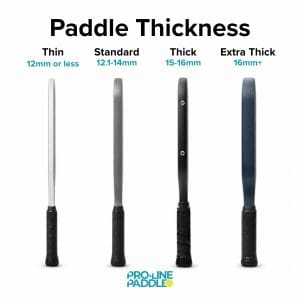
The core sits between the faces. Its material, structure and thickness affect the paddle’s response, so a comparison that looks only at the outer surface leaves out important information.
Even matching thicknesses don’t make two paddles equivalent. Two 16mm models can have different cores, faces and weight distributions. Pro-Line Paddle’s 16mm paddle guide explains why thickness belongs alongside those other specifications when you compare feel and control.
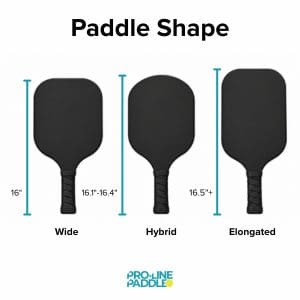
Length and width change the outline you’re swinging. Total weight tells you how much mass the paddle has, while its distribution helps explain why that mass may feel easier or harder to move.
Suppose you compare a compact paddle with an elongated one and prefer the first during quick volleys. That observation is useful, but it doesn’t prove the face material caused the difference. Record the dimensions and weight alongside your impressions.
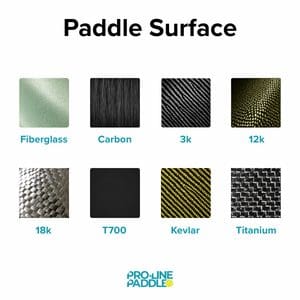
Layup means how the material layers are arranged. In a fiber composite, the direction of the fibers and the way the layers work together contribute to the finished structure. A shared fiber name does not establish an identical layup.
Texture describes the finished hitting surface. It is a separate detail from the fiber label, even when both appear in the same product description. Look for a model-specific explanation of the face and texture rather than assuming that a visible weave tells you how much spin you’ll produce.
Durability deserves the same care. A strong reinforcing fiber does not, by itself, establish how long the complete paddle or its surface finish will last. Construction quality, use and care also belong in that discussion.
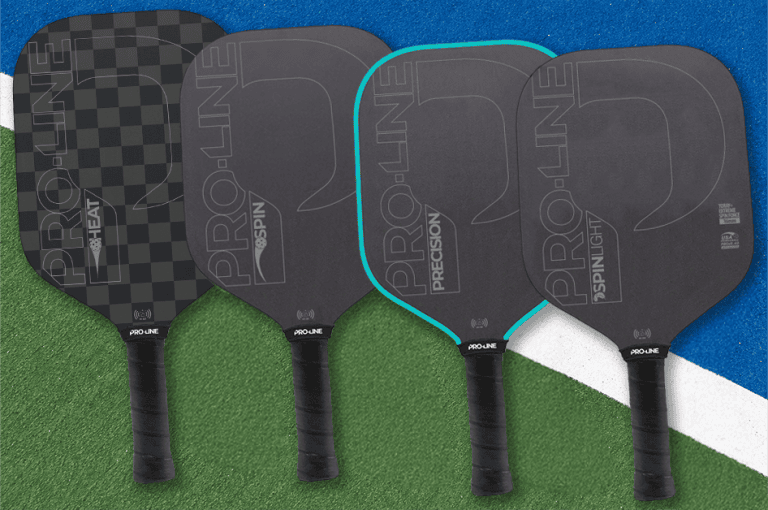
Pro-Line PRECISION lists a triple-layer T700 carbon-fiber surface and 16mm construction. Pro-Line positions the model around control, accuracy and all-around performance. Its traditional edge guard is another design detail to consider when comparing the complete paddle.
Pro-Line SPIN lists a textured Toray+ carbon-fiber surface and 16mm construction. Its stated emphasis is spin with control, and the model supports Pro-Line’s BalanceLock system for adjusting weight distribution.
Keep those descriptions distinct. T700 and Toray+ should not be treated as interchangeable specifications or as a simple ranking of good and better.
The published positioning helps you choose what to investigate. No paddle gives you a guaranteed improvement in your shots.
When you narrow a graphite vs carbon fiber pickleball paddle comparison to two or three candidates, use a short checklist:
You may end up choosing a carbon-fiber paddle because its particular construction suits your game. That’s a sound reason to buy. A broad promise about an entire material category tells you much less about the paddle you’ll actually take onto the court.
The terms describe related carbon-based materials and may overlap in commercial use. A label alone does not establish the exact fiber, resin, layup or surface finish. Compare the model’s published specifications and complete construction before drawing conclusions about performance.
No. The material name alone does not establish spin performance. Consider the finished surface and any credible model-specific test information, then try the paddle with your normal technique. Comparing two complete paddles does not isolate material as the cause of a difference.
Use material specifications to build your shortlist, then consider the paddle as a whole. Explore Pro-Line paddles to review current surface descriptions and choose a model that matches the way you want to play.
Beginner pickleball tips Buyer Guide control pickleball paddle Elevate your pickleball game Heat Heat Paddle pickleball paddle comparison Pickleball paddle guide Precision Precision Paddle Pro-Line HEAT paddle Pro-Line paddles Pro-Line Precision paddle Pro-Line Spin Light Paddle Pro-Line Spin Paddle Spin Spin Light Spin Light Paddle spin paddle Sweet spot optimization in pickleball paddles