For the best experience this application needs your location. Please allow in your browser.
For the best experience this application needs your location. Please allow in your browser.

Years of playing tennis give you a useful head start in pickleball. You can track a ball, recognize an opening and understand why placement matters. Choosing equipment, though, can feel surprisingly unfamiliar. Where are the strings? How much handle do you need? And does a strong tennis forehand mean you should buy a power paddle?
The best pickleball paddle for tennis players starts with comfortable grip fit, enough usable handle room and a design that suits the shots you want to develop. Your tennis preferences help you ask better questions. They don’t point to one automatic choice.
At Pro-Line Paddle, we suggest working through those questions before comparing our paddles. Here’s how to turn what you already know about your tennis game into a useful shopping checklist.
Think about what you like in a racquet and why. If you value maneuverability at the net, that preference belongs on your paddle checklist. If a two-handed backhand is central to your game, handle room deserves attention before surface materials.
Be equally honest about the shots you can already produce. A tennis player who generates pace easily might want to give more attention to placement and touch. Someone who enjoys attacking may still prefer a power-oriented design, provided the other fit questions check out.
Write down two priorities in plain language: “Room for my backhand” and “help choosing a paddle for controlled blocks,” for example. That’s more useful than shopping by your tennis rating or assuming that everyone with a topspin forehand needs the same paddle.
Handle length, grip circumference and overall paddle length describe different things:
For a two-handed backhand, compare your usual hand placement with clear model photos. All three shortlisted models have the same listed handle length, so an elongated paddle does not automatically provide more room. If the usable grip space is unclear, ask us before ordering.
Your tennis grip preferences can guide the questions you ask, but they do not establish a direct paddle fit.
Our elongated handle guide explores the broader fit considerations. For this purchase, focus on whether the exact model accommodates the way you intend to hold it.
A familiar baseline swing can make a paddle sound appealing on paper. Pickleball will also ask you to play compact exchanges close to the non-volley zone, commonly called the kitchen.
Picture an opponent driving directly at you. A block redirects the incoming ball with a short motion. A reset takes speed off the ball so it lands softly and helps you recover position. Neither shot depends on a full tennis backswing. Give those compact exchanges as much attention as your familiar drives when deciding what you need from a paddle.
Give these situations a place in your equipment decision. If you already supply plenty of pace, an all-around placement focus may be a sensible starting point. If topspin is a shot you want to develop, evaluate a spin-oriented design while keeping touch on your checklist.
Our paddle selection guide explains broader playing priorities. For soft-game questions, explore our control paddle guide. If you want to understand an all-court approach, read what an all-court paddle means. Keep the focus here on the tennis preferences you want to carry over and the pickleball shots that require a different approach.
You won’t be comparing string patterns or tension. Paddle specifications describe a solid hitting surface, an internal core and the way weight is distributed through the frame.
Carbon fiber identifies a material category. It doesn’t tell you exactly how every paddle will respond. Likewise, a 16mm core measurement describes thickness, not a guaranteed level of softness or control. Surface construction and the rest of the design also matter.
Weight and balance deserve separate lines on your checklist. Weight is the paddle’s total mass. Balance describes where that mass sits. Swingweight concerns resistance to rotation during a swing, so a weight in ounces alone cannot tell you how quickly a paddle will move through an exchange. Your tennis racquet’s swingweight doesn’t provide a direct paddle equivalent.
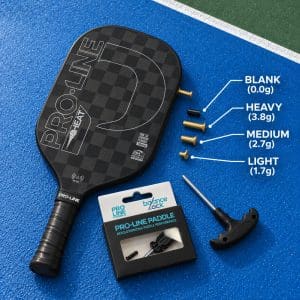
Our SPIN and HEAT models include BalanceLock, which allows weight-distribution adjustments through interchangeable inserts. If customization interests you, ask which inserts come with the current model and how the supplied setup affects total weight. You don’t need to choose a numerical configuration before you’ve settled the basic fit questions.
Start with the part of your game you want the paddle to support. We position PRECISION around versatile control and placement. SPIN is our spin-oriented option, while HEAT offers an elongated design with a controlled-power focus.
Those are design priorities, not a ranking of which paddle will make you a better player. A topspin-loving tennis player can reasonably prioritize all-around placement. A player with a one-handed backhand can still consider an elongated paddle. If your main question is choosing equipment as your pickleball skills develop, our intermediate-player paddle guide explores that separate decision.
Use this side-by-side reference to narrow your choice. Each model has a 5.5-inch handle. SPIN and HEAT weights below exclude weighted inserts; the final weight depends on the selected configuration. Check the linked product pages for current prices, options and availability.
All three models have 16mm triple-layer honeycomb cores with 8mm cells. HEAT uses a Nomex Kevlar honeycomb construction. PRECISION has a traditional edge guard, while SPIN and HEAT are edgeless and support weighted inserts. Core thickness and honeycomb cell size are different measurements. These construction details do not establish comparative spin rates or power scores.
Once a paddle meets your priorities, check availability and the final checkout price. Read our return and warranty information for the conditions that apply to a direct purchase. Warranty coverage concerns defects; it isn’t the same question as whether a paddle suits your preferences.
If competition is part of your plan, check the exact model against your event’s current equipment requirements. For USA Pickleball-sanctioned competition, consult the approved paddle list and current official rules. Another event may use different requirements. A general product description should not replace that check.
Still deciding between models? Contact our team with your priorities and a specific question: “I use a two-handed backhand. Can you help clarify the usable grip space shown in these photos?” All three handles are 5.5 inches long, so use overall shape, documented design priorities and unresolved fit questions to make the final choice.
Transitioning from tennis to pickleball gives you a new way to use skills you’ve already built. Choose equipment with the same care you gave your racquet: understand the fit and decide which playing qualities matter most.
Explore PRECISION for all-around placement, SPIN for a spin-oriented design or HEAT for controlled power in an elongated shape. Review the specifications and let us help resolve the remaining fit questions before you order.
No. If you already generate pace comfortably, you may prefer to prioritize placement and touch. A power-oriented paddle can still suit your preferences, but tennis experience alone doesn’t determine the choice.
Check handle room separately from overall paddle shape. PRECISION, SPIN and HEAT each have a 5.5-inch handle. An elongated paddle has a longer overall outline, which does not automatically mean a longer handle or a better fit for your second hand.
Your preferences can guide the questions you ask, especially about grip fit and maneuverability. Racquet weight, string tension and swingweight don’t translate directly into an equivalent paddle specification.
Look for comfortable grip fit, sufficient usable handle length and a design aligned with your touch, handling or attacking priorities. Then verify the exact model’s construction, price and purchase conditions.
No. Thickness and face material describe parts of the design. They don’t establish the complete response of a paddle. Our three shortlisted models all have 16mm cores but serve different playing priorities.

Buyer Guide Durable pickleball paddles Elevate your pickleball game Heat Heat Paddle pickleball paddle comparison Pickleball paddle guide Precision Precision Paddle Pro-Line HEAT paddle Pro-Line paddles Pro-Line Precision paddle Pro-Line Spin Light Paddle Pro-Line Spin Paddle Spin Spin Light Spin Light Paddle spin paddle Sweet spot optimization in pickleball paddles Toray+ carbon fiber pickleball paddles